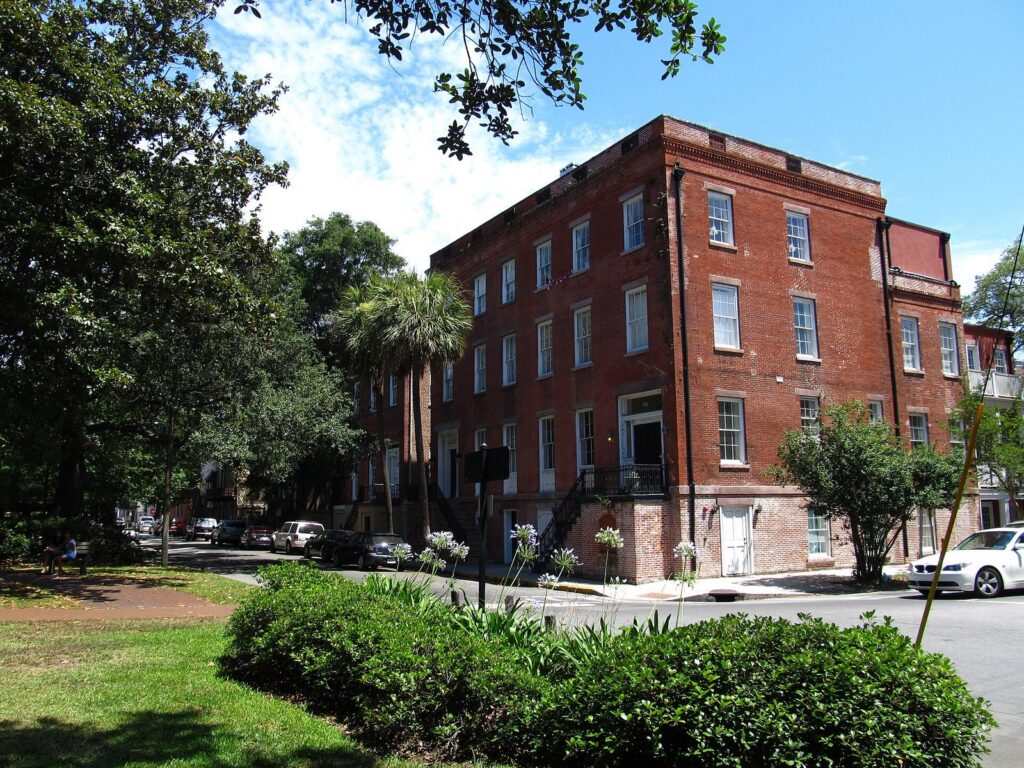
This complete Savannah Historic District visitor guide covers the National Historic Landmark district at the heart of the city: the grid of streets, wards and 22 surviving squares that grew from the plan laid out in 1733, bounded by the Savannah River, East Broad Street, Gwinnett Street and Martin Luther King Jr. Boulevard. It’s compact, flat and made for walking. The river to Forsyth Park is about a mile, and nearly everything a first-time visitor comes for, from River Street and City Market to the house museums, churches and squares, sits inside it.
The guide is for anyone planning time in downtown Savannah, whether for a day or a week. The caveat that matters is that the district isn’t uniform: its northern blocks are busy, noisy at night and inside the to-go cup zone, while its southern squares are quiet and residential, so where you spend your time, eat and sleep changes the trip. Hours, prices, transit and parking were checked October 1, 2026 against official sources. For the neighborhoods beyond downtown, see our guide to Savannah’s Historic District and neighborhoods.
The Historic District at a Glance
| Question | Short answer |
|---|---|
| Boundaries | The Savannah River (north), East Broad Street (east), Gwinnett Street (south) and Martin Luther King Jr. Boulevard (west) |
| Walking | About a mile from the river to Forsyth Park, 20 to 25 minutes without stops; flat throughout |
| Squares | 22 of the original 24 survive; Ellis Square was restored in 2010 |
| Free transit | The DOT Express Shuttle (two loops, about every 10 minutes) and the Savannah Belles Ferry |
| Parking | City garages from $1 to $2 an hour; the Visitor Day Pass covers street meters for $15 a day |
| Visitor centers | MLK Jr. Blvd (daily 9am to 4pm), City Market (10am to 5pm), River Street (10am to 6pm) |
| Money savers | Telfair’s $30 three-museum ticket; the $36 Pioneers in Preservation Pass; the Coastal Heritage Society’s $30 “See 3” |
| Quietest part | South of Jones Street, outside the to-go cup zone |
Where the Historic District Begins and Ends
The National Historic Landmark district, designated in 1966 with its boundary revised in 1977, runs from the river south to Gwinnett Street and from Martin Luther King Jr. Boulevard east to East Broad Street. Forsyth Park sits at its southern edge, and the Victorian District begins just beyond Gwinnett Street. You’ll see different figures quoted for the district’s size; the best answer for a visitor is that you can walk from one end to the other in about half an hour.
It exists in this form because people fought for it. In 1955 a group of women led by Anna C. Hunter saved the 1820 Davenport House from demolition and founded the Historic Savannah Foundation, which went on to save many more. The landmark designation followed eleven years later. That’s why so much of the 19th-century city survives, and why so many of its houses are still homes rather than museums.
How Oglethorpe’s plan works
Savannah was founded on February 12, 1733, when 114 colonists aboard the ship Anne landed at Yamacraw Bluff, about 15 miles up the river. James Oglethorpe negotiated with Tomochichi of the Yamacraw, with Mary Musgrove as interpreter, and laid out the town as a series of wards, each built around a central square. Trust lots on the east and west sides of each square were set aside for public buildings and churches, and tything lots on the north and south sides for settlers’ homes. The pattern repeated as the city grew to 24 squares; 22 survive today, after Elbert and Liberty squares were lost and Ellis Square, long a parking garage, was restored in 2010.
Read the grid and the district makes sense. Streets running north to south pass through the squares; churches and grand public buildings face them from the east and west; townhouses line the blocks between. Slavery was part of the city almost from the start. The colony’s Trustees banned it until 1750, but by 1860 Savannah counted 7,712 enslaved people among its residents, and many of the district’s grandest houses were built and run by enslaved labor. The best house museums now say so plainly.
The District in Four Bands, River to Park
The easiest way to understand the Historic District is as four east-west bands, each with its own character. Most visitors drift north to south over a day or two.
1. The riverfront: River Street, Factors Walk and Bay Street
At the top of the map, Bay Street runs along the bluff past City Hall’s gold dome, and River Street sits below it in the old cotton warehouses, with Factors Walk’s iron bridges connecting the two. It’s the busiest, loudest and most commercial part of the district, with the free Belles Ferry, harbor cruises, candy shops and dozens of bars. Our River Street visitor guide covers it in detail.
2. The market band: City Market, Broughton Street and the northern squares
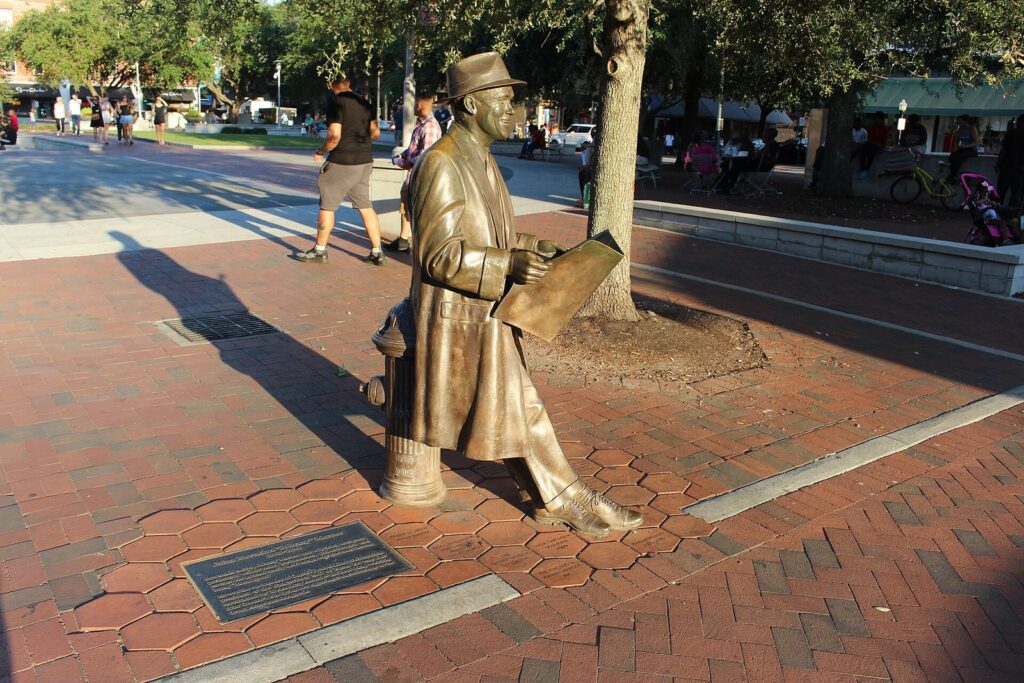
Between Bay Street and Oglethorpe Avenue is downtown’s working center. City Market’s four blocks of restored warehouses sit beside Ellis Square, where Johnny Mercer’s statue stands and the City lists an interactive fountain, seating and public restrooms. Broughton Street, the main shopping street, runs through the middle, with Leopold’s Ice Cream at number 212 East. The squares here include Johnson, the first one laid out; Reynolds, with The Olde Pink House; Wright; Telfair, flanked by the Telfair Academy and the Jepson Center; Franklin, with First African Baptist Church and the monument to the Haitian soldiers who fought in the 1779 Siege of Savannah; and Oglethorpe and Columbia, home to the Owens-Thomas House and the Davenport House.
3. The middle squares: Oglethorpe Avenue to Jones Street
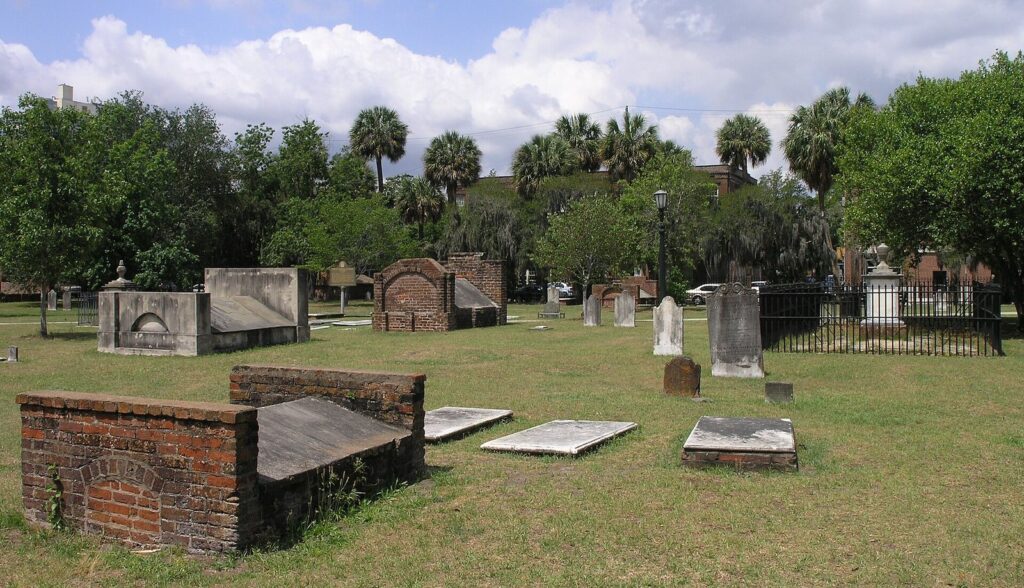
South of Oglethorpe Avenue, the district quiets down. Chippewa Square, Madison Square with the Sorrel-Weed House, and Lafayette Square, with the Cathedral Basilica of St. John the Baptist, the Andrew Low House and Flannery O’Connor’s childhood home, are the highlights. Colonial Park Cemetery, the city’s old burial ground, sits on Abercorn Street at Oglethorpe Avenue. This band is still inside the to-go cup zone, but the bars thin out and the historic inns take over.
4. The southern squares and Forsyth Park: Jones Street to Gwinnett Street
Below Jones Street, the district is residential and leafy. Monterey Square, with the Mercer Williams House and Congregation Mickve Israel’s Gothic Revival synagogue, is the quietest and many visitors’ favorite. The Massie Heritage Center explains the city plan, and Forsyth Park anchors the southern edge. Our Forsyth Park visitor guide covers the park itself.
The edges
On the western edge, Martin Luther King Jr. Boulevard holds the MLK Visitor Information Center, the Savannah History Museum, the Ralph Mark Gilbert Civil Rights Museum and, near the river, The Grey and the Ships of the Sea Maritime Museum. On the eastern edge, East Broad Street leads to The Pirates’ House and, along the river, Eastern Wharf.
A First Walk: Bull Street From the River to the Park
If you only take one walk, take this one. Bull Street is the district’s spine, running south from City Hall through five squares to the Forsyth Park fountain. It’s about a mile and takes an hour with stops.
- City Hall. Start under the gold dome on Bay Street, with the river and River Street below you. The outdoor elevator beside City Hall is the easy way down if you want a look first.
- Johnson Square. The first square laid out, ringed by banks and churches; the city’s commercial heart since the colony’s early years.
- Wright Square. Tomochichi, the Yamacraw leader who negotiated with Oglethorpe, was buried here, and a granite boulder marks his memory.
- Chippewa Square. Oglethorpe’s bronze statue stands at the center. This is also where Forrest Gump sat, though the bench was a film prop and now lives in the Savannah History Museum.
- Madison Square. The Sorrel-Weed House faces the square, and the monument honors Sergeant William Jasper, killed in the 1779 Siege of Savannah.
- Monterey Square. The quietest of the five, with the Mercer Williams House, Congregation Mickve Israel and the monument to Casimir Pulaski, mortally wounded in the same siege.
- Forsyth Park. Finish at the 1858 fountain, then walk the oak avenue or ride the free DOT shuttle’s Forsyth loop back north.
The Landmarks Worth Your Time
Hours and prices below are as the sites listed them on October 1, 2026.
| Landmark | Open | Adult price |
|---|---|---|
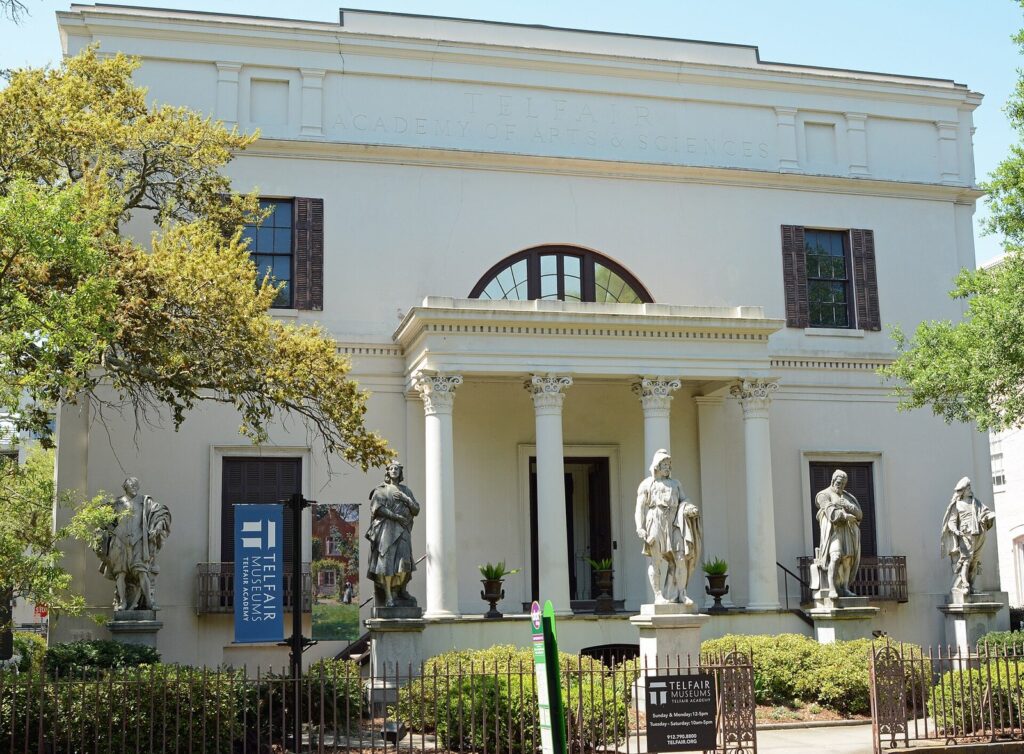
| Telfair Academy, Jepson Center and Owens-Thomas House | Tuesday to Sunday, 10am to 5pm | $30 for all three, valid seven days |
| Davenport House | Monday to Saturday, timed tours | Included in the Pioneers in Preservation Pass |
| Andrew Low House | Monday to Saturday 10am to 4pm; Sunday noon to 4pm | $15 |
| Juliette Gordon Low Birthplace | Confirm hours at 912-233-4501 | $15; book online ahead in summer |
| Mercer Williams House | Daily; tours every 20 to 40 minutes | $14.95 plus tax |
| Cathedral Basilica of St. John the Baptist | Monday to Saturday 9 to 11:30am and 1 to 4:30pm; Sunday 1 to 4:30pm | Free; $3 suggested donation |
| First African Baptist Church | History tour Monday to Saturday at 1pm | $15 |
| Ralph Mark Gilbert Civil Rights Museum | Tuesday to Saturday; last tour 3:30pm | $15 |
| Savannah History Museum | Daily, 9am to 4pm | $12 |
| Ships of the Sea Maritime Museum | Daily, 10am to 5pm | $17.50 |
| American Prohibition Museum | Daily, 10am to 5pm | From $17.57 |
| Massie Heritage Center | Monday to Saturday, 10am to 4pm | $10 |
| Flannery O’Connor Childhood Home | Thursday to Sunday; tours at 11am, 1pm and 3pm | Check when booking |
| SCAD Museum of Art | Closed Tuesdays | Check current admission |
| Colonial Park Cemetery | 8am to 5pm November to March; 8am to 8pm March to November | Free |
If you have time for only two, make one a house museum with a strong story (the Owens-Thomas House and Slave Quarters tells the whole household’s history best) and the other a stop that explains the city: the Telfair Academy, the Savannah History Museum or First African Baptist Church’s 1pm tour. Our guide to Savannah attractions ranks the rest.
Free Things to Do in the District
- Walk all 22 squares, at your own pace and in any order.
- Stroll Forsyth Park, and on Saturdays browse the Forsyth Farmers’ Market from 9am to 1pm.
- Walk River Street and Factors Walk, and see the Waving Girl and the African-American Monument on the riverfront.
- Ride the Savannah Belles Ferry across the river and back for the best skyline view in town.
- Wander City Market and its upstairs Art Center, where artists work in their studios.
- Read the headstones in Colonial Park Cemetery, open from 8am.
- Step into the Cathedral Basilica of St. John the Baptist, where a $3 donation is suggested.
- Loop the district on the free DOT Express Shuttle when your feet give out.
Passes That Save Money
- Telfair Museums ticket: $30 for adults covers the Telfair Academy, the Jepson Center and the Owens-Thomas House and Slave Quarters, valid for seven days. It’s the best value in the district.
- Pioneers in Preservation Pass: $36 plus tax covers Ships of the Sea, the Davenport House and the Andrew Low House, valid for seven days.
- Coastal Heritage Society “See 3”: $30 for any three of its sites, the Savannah History Museum, the Georgia State Railroad Museum, Old Fort Jackson and the Pin Point Heritage Museum, valid for three days once used.
All three are simple to buy at the first site you visit. Pick the one that matches the houses and museums you actually want; a pass only saves money if you use it.
Getting Around the District
Walking is the default. The grid is flat, the squares break up every few blocks, and nothing is more than about 30 minutes apart on foot. Bull Street, which runs from City Hall through five squares to Forsyth Park, is the spine to learn first.
The free DOT Express Shuttle from Chatham Area Transit runs two loops, Forsyth and Downtown, with 18 stops, about every 10 minutes: 7am to 7pm on weekdays, 10am to 6pm at weekends and 10am to 6:30pm on holidays, with no service on Thanksgiving, Christmas or New Year’s Day. It’s ADA compliant. The Savannah Belles Ferry crosses the river free from 7am to 10pm.
Tours are another way to cover ground: narrated trolleys, carriages and bike tours all work the district. Our Savannah tours compared by interest and budget lays out prices and fine print. For rideshares, taxis and the airport, see our getting around Savannah guide.
Parking in the Historic District
If you drive, park once and walk. The City’s garages are open 24 hours and take cards only:
| Garage | Rates |
|---|---|
| Bryan Street, Robinson and State Street | $2 an hour, $20 weekday maximum, $5 flat at weekends |
| Whitaker Street (under Ellis Square) and Eastern Wharf | $2 an hour, $24 weekday maximum, $10 at weekends |
| Liberty Street | $1 an hour, $14 maximum |
Special-event days run about $25. For street parking, the City’s Visitor Day Pass costs $15 for 24 hours or $24 for 48 hours and covers on-street meters, though not garages or street-sweeping zones. Buy it at the Mobility and Parking Services office in the Bryan Street Garage, 100 E. Bryan Street, with your plate number; the MLK visitor center no longer sells parking passes.
Noise, Nightlife and the To-Go Cup Zone
Savannah allows alcoholic drinks in to-go cups on the street within a zone that runs from the river south to Jones Street, west to the Talmadge Bridge and east past Savannah River Landing. That’s the single best predictor of where the district is lively at night. River Street and City Market carry most of the bar traffic, the market band stays busy into the evening, and the middle squares are calmer. South of Jones Street, including Monterey Square and Forsyth Park, the zone ends and the evenings are quiet. On St. Patrick’s Day the whole northern half becomes a street party; in 2026 the City closed the City Market and River Street areas from 6am on the Friday before the parade.
Where to Eat and Where to Stay
Eating. The district holds most of Savannah’s famous tables: Mrs. Wilkes’ Dining Room on West Jones Street, The Olde Pink House on Reynolds Square, Husk Savannah, The Grey on Martin Luther King Jr. Boulevard, Leopold’s on Broughton Street and The Collins Quarter on Bull Street and in Forsyth Park. Our guide to the best Savannah restaurants for first-time visitors has hours, booking rules and the closures to avoid.
Staying. The market band is the most convenient base, the middle squares are the best balance of quiet and access, and the southern squares are the calmest. Riverfront rooms trade noise for views. Our guide to the best area to stay in Savannah for first-time visitors compares each band, with taxes and parking.
Accessibility
The district is flat, which Visit Savannah rightly calls a help, but brick sidewalks, tree roots, cobblestones and old buildings make it uneven in practice. Plan around the sites that work for you. The Jepson Center has an elevator to all three levels, the Juliette Gordon Low Birthplace has full elevator access from a street-level garden entrance, the American Prohibition Museum is fully ADA compliant, and the cathedral’s elevator entrance is on Harris Street. The Owens-Thomas House has no elevator, the Andrew Low House can’t accommodate wheelchairs, the Mercer Williams House isn’t licensed as handicap accessible, and Flannery O’Connor’s childhood home has several flights of stairs. The DOT shuttle and Belles Ferry are both accessible, and River Street has two public elevators. Our accessible Savannah travel guide covers equipment rental and paratransit.
Etiquette, Safety and Comfort
- People live here. Most houses on the squares are private homes. Admire from the sidewalk, keep off the stoops and keep evening voices down in the residential squares.
- Cemetery hours. Colonial Park Cemetery closes at 5pm in winter and 8pm the rest of the year; night tours talk about it from the sidewalk.
- Drinks. To-go cups are fine north of Jones Street and not south of it.
- Heat. From June to September, sightsee early and late and take the middle of the day indoors; the squares’ shade helps, but the streets between them bake.
- Nights. The northern blocks stay busy late. As in any city, keep to lit streets with people around, and take a rideshare rather than crossing empty blocks alone late at night.
On a Rainy Day
Savannah’s showers tend to be heavy and short, and the district has plenty of indoor cover. The Telfair Academy and the Jepson Center, on one ticket, can fill a wet morning from Tuesday to Sunday. The American Prohibition Museum and Ships of the Sea Maritime Museum open daily from 10am to 5pm, the Savannah History Museum daily from 9am to 4pm, and the SCAD Museum of Art every day but Tuesday. City Market’s upstairs Art Center and the shops of Broughton Street fill the gaps, and Leopold’s is always a good place to wait out a storm.
When to Visit
Spring brings azaleas, the city’s biggest crowds and its biggest party around St. Patrick’s Day, so book early. Summer is hot and humid, which pushes walking into mornings and evenings. Fall is mild and busy with festivals, and winter is the quiet season, when the live oaks stay green and the house museums are uncrowded. Whatever the season, early morning is the district at its best, when the squares belong to dog walkers and the light is soft. For month-by-month detail, see our guide to the best time to visit Savannah.
Savannah Historic District FAQ
What are the boundaries of Savannah’s Historic District?
The National Historic Landmark district runs from the Savannah River south to Gwinnett Street and from Martin Luther King Jr. Boulevard east to East Broad Street. Forsyth Park sits at its southern edge, River Street at its northern edge, and the Victorian District begins just south of Gwinnett Street. It was designated in 1966, with its boundary revised in 1977.
How many squares are in Savannah’s Historic District?
Twenty-two of the original 24 squares survive. Elbert and Liberty squares were lost, and Ellis Square, which spent decades under a parking garage, was restored in 2010. Each square sits at the center of a ward laid out under Oglethorpe’s plan, with churches and public buildings on two sides and homes on the other two.
Is Savannah’s Historic District walkable?
Very. It’s flat, and the river to Forsyth Park is about a mile, a 20 to 25-minute walk without stops. Squares every few blocks give you shade and places to sit. The free DOT Express Shuttle runs two loops about every 10 minutes for tired legs, and the Belles Ferry crosses the river free.
Where should I park in the Historic District?
In a City garage, then walk. Rates run $1 to $2 an hour, with weekday maximums of $14 to $24 and weekend flat rates of $5 to $10. For street meters, the Visitor Day Pass costs $15 for 24 hours or $24 for 48, bought at the Bryan Street Garage with your plate number.
What’s free to see in the Historic District?
A great deal: all 22 squares, Forsyth Park, River Street, Factors Walk, City Market, Colonial Park Cemetery and the outsides of the house museums. The Cathedral Basilica asks only a $3 suggested donation, and the DOT shuttle and Belles Ferry are free. A full day of walking can cost nothing beyond lunch.
Is the Historic District safe to walk at night?
The northern blocks, around River Street and City Market, stay busy into the night, and the residential squares to the south get very quiet. Use ordinary city sense: stay on lit streets with other people around, keep valuables out of sight in parked cars, and take a rideshare rather than walking long, empty stretches late at night.
How long do you need in Savannah’s Historic District?
One full day covers the highlights: a walk down Bull Street, one or two museums, River Street and City Market. Two days let you add house tours, First African Baptist Church’s 1pm tour and a slower look at the southern squares and Forsyth Park, plus a morning at Bonaventure or Wormsloe outside the district. Three days or more leave time to simply wander.
Related Savannah Guides
- Savannah Historic District and Neighborhoods: downtown and the neighborhoods beyond it
- River Street Visitor Guide: the riverfront band in detail
- Forsyth Park Visitor Guide: the park at the district’s southern edge
- Two Days in Savannah Itinerary: an hour-by-hour plan for the district and beyond
- Best Savannah Tours Compared by Interest and Budget: guided ways to see it
Sources and How We Checked
Hours, prices, transit, parking and visitor-center details were checked on October 1, 2026. This guide is compiled from the National Park Service, the City of Savannah, Chatham Area Transit, Visit Savannah, the museums and sites listed and the New Georgia Encyclopedia, not from other travel guides, and we don’t claim first-hand visits.
- History and boundaries: National Park Service, Savannah Historic District; Savannah Historic District marker; New Georgia Encyclopedia, Savannah
- City of Savannah: parking garages; visitor parking; Colonial Park Cemetery; to-go cup ordinance
- Chatham Area Transit: DOT Express Shuttle; Savannah Belles Ferry
- Visit Savannah: visitor information centers; accessibility
- Museums and houses: Telfair Museums; Davenport House and the Pioneers in Preservation Pass; Andrew Low House; Juliette Gordon Low Birthplace; Mercer Williams House; Ships of the Sea; American Prohibition Museum; Massie Heritage Center; Flannery O’Connor Childhood Home; Coastal Heritage Society; See 3 ticket
- Churches and heritage sites: Cathedral Basilica; First African Baptist Church; Ralph Mark Gilbert Civil Rights Museum
- News: WTOC on St. Patrick’s Day closures
Savannah Tourism Guide is an independent publication. We are not affiliated with Visit Savannah, the City of Savannah or any attraction listed here, and no one paid to be included.
Photo Credits
- Oglethorpe Square: photo by Ken Lund, Wikimedia Commons (CC BY-SA 2.0)
- Johnny Mercer statue, Ellis Square: photo by Michael Rivera, Wikimedia Commons (CC BY-SA 4.0)
- Telfair Academy: photo by Bubba73 (Jud McCranie), Wikimedia Commons (CC BY-SA 4.0)
- Colonial Park Cemetery: photo by Daniel Mayer, Wikimedia Commons (CC BY-SA 3.0)