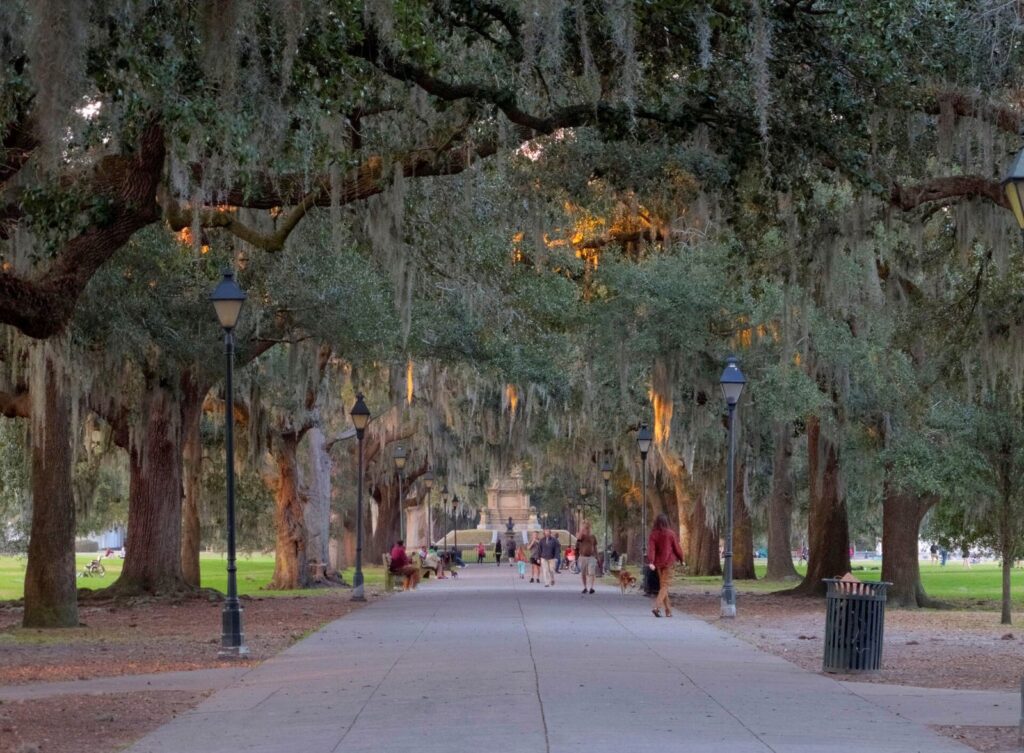
This Forsyth Park visitor guide covers the Historic District’s largest park: 30 acres of live oaks, lawns and paths on the district’s southern edge, with Savannah’s famous 1858 fountain at the north end. It’s free, there’s no gate or ticket, and you can see the fountain in ten minutes, but the park rewards an unhurried hour. Come on a Saturday morning and the farmers’ market at the south end turns a photo stop into one of the best mornings in town.
The guide is for anyone fitting the park into a Savannah trip, from a 20-minute look to a slow afternoon, with or without kids or a dog. The caveat that matters: the fountain is switched off now and then for maintenance, and summer middays are hot even under the oaks. Facilities, transit and event details were checked October 1, 2026 against official sources. For the rest of the city’s big sights, see our guide to Savannah attractions and landmarks.
Forsyth Park at a Glance
| Question | Short answer |
|---|---|
| Cost | Free; no tickets or reservations |
| Time needed | 20 minutes for the fountain; 1 to 1.5 hours to walk the park; about 2 hours on a Saturday with the market |
| Best time | Early morning for soft light and few people; Saturday 9am to 1pm for the market; late March and early April for azaleas |
| Getting there | About a mile south of River Street, a 20 to 25-minute walk; the free DOT Express Shuttle’s Forsyth loop |
| Parking | Street parking on the surrounding blocks; the City’s Visitor Day Pass covers meters for $15 a day |
| Accessibility | The park and its 1.5-mile walking trail are ADA accessible |
| Dogs | Welcome on a leash, with dog water fountains and waste bins |
| Drinks | Outside the to-go cup zone, so no open alcohol |
What to See in Forsyth Park
The park is a long rectangle bounded by Gaston Street to the north, Park Avenue to the south, Whitaker Street to the west and Drayton Street to the east. The fountain and the shadiest walks fill the northern half; the southern half opens up into lawns, courts, playgrounds and the Saturday market.
The fountain
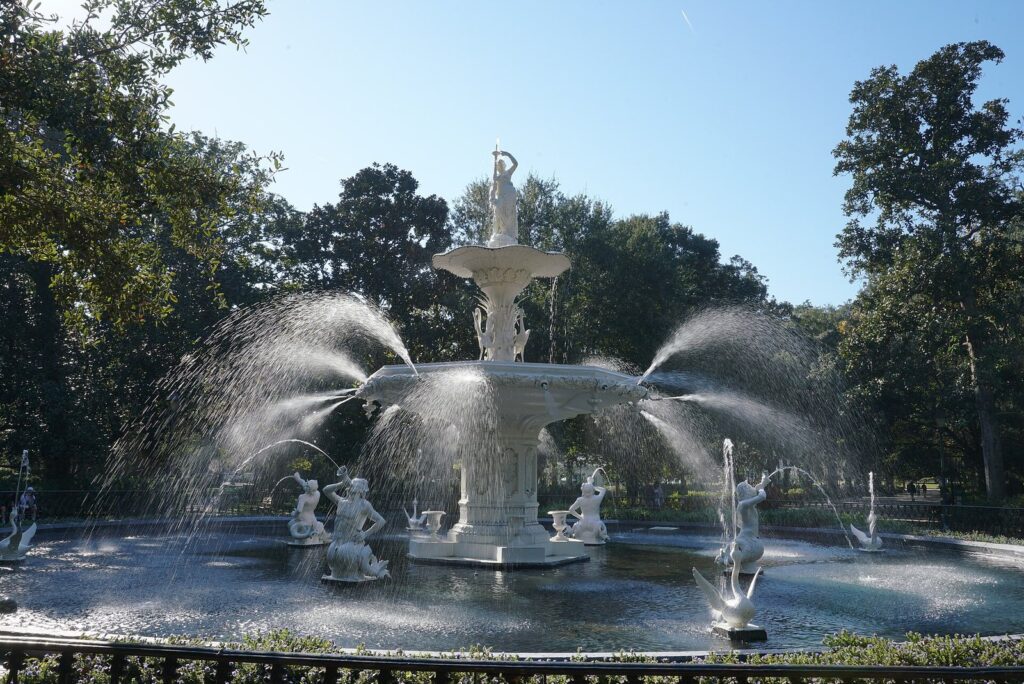
The fountain at the park’s north end is the image on half the postcards in Savannah, and it’s even better in person: tiers of white cast iron, spouting tritons and swans, and a robed figure on top, all inside a low iron fence. It’s not a one-of-a-kind sculpture. According to the City, it was ordered from the catalog of the New York ironworks Janes, Beebe & Co. as “Model #5,” installed in July 1858 and first turned on that August.
It has recently had the care it needed. In 2025 the City removed the fountain for its first major restoration since 1988, a project of about $650,000, and the water came back on December 19, 2025. It’s still shut down periodically for maintenance, so don’t be surprised to find it dry. For photographs, come early. It’s a favorite backdrop for wedding and engagement pictures, and the fence gets busier as the morning goes on.
Plan it: Free and always visible from the sidewalk. Enter at Gaston Street, at the head of Bull Street. Allow 10 to 20 minutes, longer if you’re waiting for a clear shot.
The oak walks and the walking trail
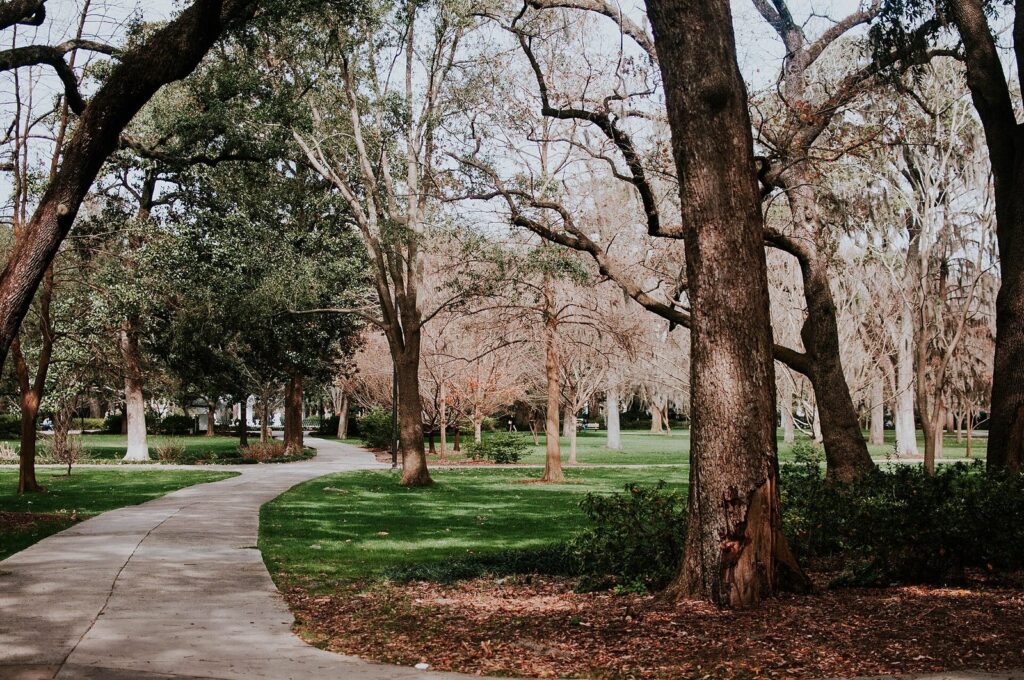
South of the fountain, a wide paved walk runs down the middle of the park under a tunnel of live oaks and Spanish moss, lined with benches and old lamp posts. This is the walk to take slowly. The light filters through the moss, the city noise drops away, and on a weekday morning you’ll share it mostly with joggers and dog walkers. A 1.5-mile walking trail runs through the park for anyone who wants a proper stretch of the legs.
The gardens
Two gardens are easy to miss. The Garden of Fragrance is a small garden of scented plants that closes at 2pm, so visit it early. The Shade Garden, on the central west side of the park, is the newest addition; it opened on February 18, 2026. Neither takes long, and both are worth the detour on a hot day.
The Civil War memorial at the center
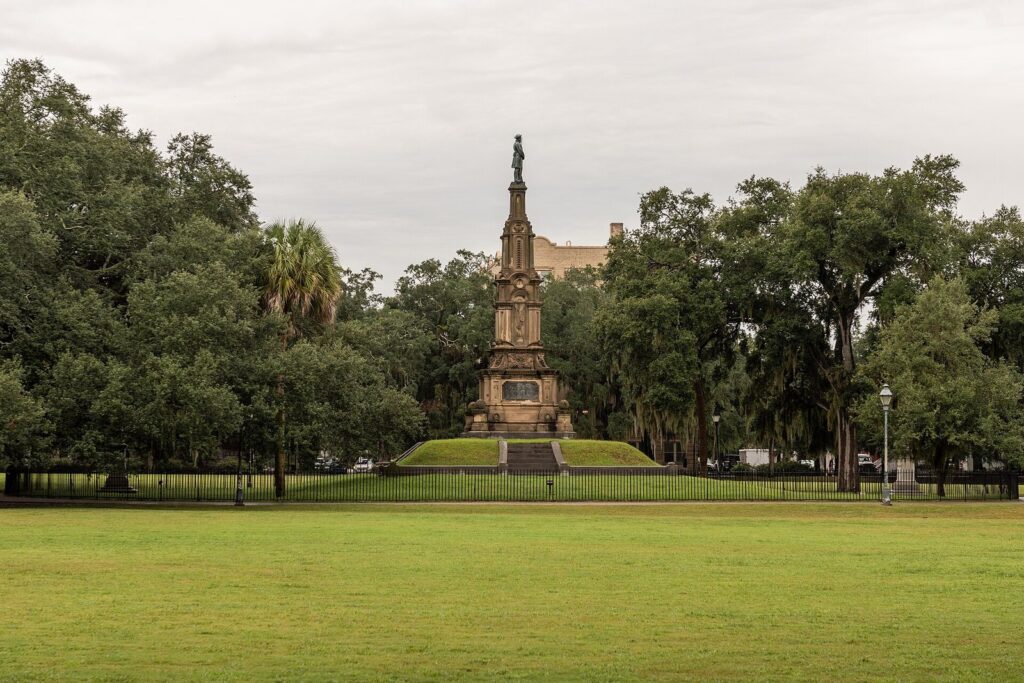
At the center of the park stands a tall monument to the Confederate dead, dating to the 1870s, with a soldier on top; nearby are busts of two Confederate officers, Francis Bartow and Lafayette McLaws. It honors men who fought to preserve slavery, and Savannah has argued about it for years. After a City task force made recommendations, the City Council approved changes, including renaming it a Civil War memorial, adding a plaque honoring all of the war’s dead and moving the busts to Laurel Grove North Cemetery, where both men are buried. News reports since then say the busts stayed put because Georgia law restricts relocating monuments. Look at it as a document of how the city chose to remember the war.
The south lawns, courts and playgrounds
The southern half began as a parade and drill ground, and it still feels like a field day. There are open lawns for frisbee and picnics, two basketball courts, tennis courts, volleyball nets, the Forsyth Park Band Shell for performances, and playgrounds. The main playground reopened on September 30, 2025 after its surface was replaced and expanded, and the City has plans for adult fitness equipment, more swings, an upgraded splash pad and a new splash-pad play area. The tennis courts went into renovation in late June 2026 with a target finish in mid-September, so check that they’ve reopened before you bring a racket.
Collins Quarter at Forsyth, a café inside the park, is the place for coffee, a pastry or a late breakfast between the fountain and the lawns.
The farmers’ market
Every Saturday from 9am to 1pm, year-round and rain or shine, the Forsyth Farmers’ Market sets up at the south end of the park near Bull Street and Park Avenue. It’s a working market for locals rather than a souvenir fair, with local produce, baked goods and prepared food. It accepts SNAP/EBT and doubles those benefits, and it’s the easiest place in town to put together a picnic for the lawn.
A Self-Guided Walk Through Forsyth Park
This route covers the whole park in about an hour at an easy pace, north to south, and ends where you can either loop back on the walking trail or keep going into the Victorian District.
- Start at the fountain, at Gaston and Bull streets. Walk the fence line for the close-up details, then step back across the path to frame it with the oaks. (10 minutes)
- Find the Garden of Fragrance before 2pm. It’s small and easy to walk past, so slow down and use your nose. (10 minutes)
- Walk the central promenade south. This is the oak tunnel from the postcards: benches, lamp posts and moss overhead. Take it slowly. (10 minutes)
- Detour west to the Shade Garden. The park’s newest garden opened in February 2026 on the central west side. (5 to 10 minutes)
- Stop at the memorial in the middle. Read the inscriptions with the history below in mind; it’s the park’s most argued-over landmark. (5 minutes)
- Take a break at Collins Quarter at Forsyth. The cafe inside the park is the natural halfway stop. (15 minutes)
- Cross the south lawns. Courts, fields, the band shell and the playground fill the southern half, and on Saturday mornings the market takes over the south end near Bull Street and Park Avenue. (15 minutes, or an hour on market day)
- Finish south or loop back. Step out into the Victorian District’s streets of wooden houses, or follow the walking trail back toward the fountain.
How Long to Spend: Four Ways to Do Forsyth Park
| Visit | Time | What it covers |
|---|---|---|
| The quick look | 20 to 30 minutes | The fountain, a stretch of the oak walk and back north to the squares |
| The full walk | 1 to 1.5 hours | The fountain, both gardens, the memorial, the café and the south lawns along the walking trail |
| Saturday morning | About 2 hours | The market from 9am, coffee at the café and the fountain on the way out |
| A slow afternoon | 2 hours or more | A picnic on the lawn, a book under the oaks and the band shell if something’s on |
If you’re following our two-day Savannah itinerary, the park is the turnaround point of day one, reached after a walk down Bull Street through Chippewa, Madison and Monterey squares.
When to Go
Time of day. Early morning is the park at its best. The light is soft, the fountain is quiet, and the joggers and dog walkers give it a neighborhood feel. Late afternoon is the next best, when the sun drops behind the oaks. Midday in summer is the time to be somewhere with air conditioning.
Day of the week. Saturday morning brings the farmers’ market and the most life. Weekday mornings are the calmest, and Sundays are a mix of picnics, pickup games and families.
Season. Spring is peak season, with azaleas around the park and the surrounding blocks at their best in late March and early April, and the city’s busiest crowds. Summer is hot and humid; come early or late. Fall is mild and busy with festivals. In winter the live oaks stay green while the park’s other trees go bare, and you’ll often have the paths to yourself. For month-by-month weather, see our guide to the best time to visit Savannah.
Getting There, Parking and Getting Around
On foot. From River Street, the park is about a mile south, 20 to 25 minutes without stops. The best route is straight down Bull Street, which takes you through five squares and past some of the district’s finest houses before ending at the fountain.
By free shuttle. The DOT Express Shuttle, run by Chatham Area Transit, has a Forsyth loop with stops near the park. Buses come about every 10 minutes from 7am to 7pm on weekdays and 10am to 6pm at weekends, with holiday hours of 10am to 6:30pm and no service on Thanksgiving, Christmas or New Year’s Day. The shuttle is ADA compliant.
By car. Street parking surrounds the park, and it’s easier to find here than in the northern half of the district. The City’s Visitor Day Pass covers on-street parking for $15 for 24 hours or $24 for 48 hours; it isn’t valid in garages or street-sweeping zones, and you buy it at the Mobility and Parking Services office in the Bryan Street Garage, 100 E. Bryan Street, with your plate number. Our getting around Savannah guide covers garages, meters and rideshares.
By bike. Cycling in the park is governed by City ordinance, so follow the posted rules and walk your bike where the paths are busy.
Accessibility
Forsyth Park is one of the easiest major sights in Savannah for wheelchair users and families with strollers. Visit Savannah describes the park and its walking trail as ADA accessible, the ground is flat, and the main walks are paved. Benches line the central promenade, and the free DOT shuttle is ADA compliant. Restrooms are limited, so plan stops around the café or your hotel. For step-free routes and equipment rental elsewhere in the city, see our accessible Savannah travel guide.
Forsyth Park With Kids
For families, Forsyth Park is the best free afternoon in the Historic District. The main playground reopened on September 30, 2025 on a new, larger rubber-mulch surface, and the City’s next round of upgrades includes more swings, an upgraded splash pad and a new splash-pad play area. The lawns give children room to run that the squares can’t, the cafe sells snacks, and on Saturday mornings the market adds treats and a bit of bustle. Shade is good under the oaks but thin on the open lawns of the south half, so bring water and hats from May to September. Restrooms are limited; know where the cafe and your next stop are before anyone needs one. For more family ideas, see our Savannah with kids guide.
Photography Tips
- The fountain. Shoot it in the first hour after sunrise, when the light is soft and the fence is empty. Step back across the path to frame it with oaks and moss.
- The oak walk. Late-afternoon light slants through the moss, and a longer lens compresses the tunnel of trees.
- Spring color. Azaleas peak around the park and the surrounding blocks in late March and early April.
- Other people’s big day. Wedding and engagement shoots use the fountain often; wait your turn and keep out of their frames.
- Dry days. If the fountain is off for maintenance, the cast iron still photographs well, and the oak walk is unaffected.
Comfort and Safety
Savannah’s heat is the main hazard. From June to September, midday heat and humidity make even a shady walk tiring, so carry water and plan the park for morning or evening. On still, warm days the coast’s tiny biting sand gnats can be a nuisance, and insect repellent helps. By day the park is busy and well used. After dark, keep to the main walks with lamp posts and the edges near the streets, as you would in any city park, and avoid cutting across empty lawns alone.
Park Rules and Etiquette
- No open alcohol. Savannah’s to-go cup zone stops at Jones Street, and Forsyth Park is outside it, so leave your drink behind.
- Dogs on leashes. The park has dog-friendly waste bins and water fountains; use them.
- Fountain manners. Admire it from the fence. It’s a restored 1858 casting, not a wading pool.
- Bikes. Follow the City’s posted rules, and give walkers room on the central promenade.
- Events. Festivals and permitted events can take over the lawns and band shell; check the City’s or the organizer’s calendar before planning a picnic on a festival weekend.
Events in Forsyth Park
Beyond the weekly market, the park is Savannah’s favorite festival ground. The free Savannah Jazz Festival fills it in mid to late September; the 2026 edition, the 45th, ran September 18 to 20. SCAD’s annual Sidewalk Arts Festival turns the park’s paths into a gallery of chalk drawings. The Savannah Pride Festival lists Saturday, October 24, 2026 in the park, with free entry to the main festival; confirm details with the organizer. Concerts and performances also come to the band shell through the year. Our Savannah events and festivals guide keeps the calendar.
A Short History of Forsyth Park
The park takes its name from John Forsyth, the Georgia governor, and the City dates it to 1851, when Savannah was growing south beyond Oglethorpe’s grid of squares. The fountain followed in 1858. The southern extension served for years as a parade and drill ground, which is why it’s still open lawn today, and the Confederate memorial went up at the center in the 1870s.
The 21st century has brought steady change. The fountain’s 2025 restoration, the playground’s 2025 rebuild, the 2026 Shade Garden and the tennis court renovation are part of a run of City improvements. Meanwhile the memorial at the center remains, still contested. For the bigger story of how Savannah grew from Oglethorpe’s plan, see our Savannah history guide.
Where to Eat, Drink and Stay Nearby
Inside the park, Collins Quarter at Forsyth handles coffee and brunch. Facing the park, Hotel Bardo, which opened in February 2024 in the 19th-century mansion on the park’s east side, runs the restaurant Saint Bibiana. For something casual, Starland Yard’s food trucks and bar are a short ride south in the Starland District, open Monday to Thursday 5 to 10pm, Friday and Saturday noon to 10pm and Sunday noon to 9pm. And on Saturdays, the market itself is lunch. Our guide to the best Savannah restaurants for first-time visitors covers the rest of the city.
If you’d like to wake up near the park, Hotel Bardo, The Gastonian, an inn of two 1868 mansions two blocks away, the Forsyth Park Inn and The Whitman are all close by. Staying here means quiet nights and a 20-minute walk to River Street. Our guide to the best area to stay in Savannah for first-time visitors weighs that trade-off.
Nearby Stops Worth Pairing
| Stop | From the fountain | Why pair it |
|---|---|---|
| Monterey Square and the Mercer Williams House | About 5 minutes north on Bull Street | The quietest square; house tours every 20 to 40 minutes, adults $14.95 plus tax |
| Massie Heritage Center | About 10 minutes northeast | Savannah’s city plan explained; Monday to Saturday, 10am to 4pm, adults $10 |
| Madison Square and the Sorrel-Weed House | About 10 minutes north | History and architecture tours by day, ghost tours at night |
| Cathedral Basilica of St. John the Baptist | About 15 minutes north | Open to sightseers Monday to Saturday, 9 to 11:30am and 1 to 4:30pm |
| The Victorian District | Directly south of the park | Wooden Victorian houses and quiet streets from Gwinnett Street to Anderson Street |
| Starland Yard | A short ride south | Food trucks, a bar and a local crowd |
A half day around the park
For a relaxed half day, start at the fountain or the farmers’ market at 9am, walk the park south and back, then head a block north to Monterey Square for the Mercer Williams House, whose tours run from 10:30am Monday to Saturday and from noon on Sundays. Stop at the Massie Heritage Center, open Monday to Saturday from 10am, to see how Oglethorpe’s plan of wards and squares was laid out, then continue up Bull Street to Madison Square and lunch near the cathedral. You’ll have covered the southern half of the Historic District at a stroll by early afternoon, before the day’s heat peaks.
Forsyth Park FAQ
Is Forsyth Park free?
Yes. There’s no admission charge, no ticket and no reservation for the park, the fountain, the gardens or the walking trail. The Saturday farmers’ market is free to browse, and many of the festivals held in the park, including the Savannah Jazz Festival, are free too. You’ll only spend money on food, coffee or the occasional ticketed event at the band shell.
How long should I spend at Forsyth Park?
Twenty to thirty minutes covers the fountain and a stretch of the oak walk. An hour to an hour and a half lets you walk the length of the park, see both gardens and the memorial, and stop for coffee. On a Saturday, give it about two hours so you can browse the farmers’ market, which runs from 9am to 1pm.
Is the Forsyth Park fountain running?
Yes. The fountain was removed in 2025 for its first major restoration since 1988, a project of about $650,000, and its water came back on December 19, 2025. The City still turns the water off periodically for maintenance, so you may occasionally find it dry. Even then, the cast-iron fountain itself is worth seeing.
Where do I park for Forsyth Park?
On the street around the park, where spaces are easier to find than in the northern Historic District. The City’s Visitor Day Pass covers on-street meters for $15 for 24 hours or $24 for 48 hours, but not garages or street-sweeping zones. Or skip the car: the free DOT Express Shuttle’s Forsyth loop runs about every 10 minutes during the day.
Can you drink alcohol in Forsyth Park?
No open alcohol. Savannah’s to-go cup zone, which allows drinks on the street, runs from the river south only to Jones Street, and Forsyth Park and Monterey Square are outside it. For a drink near the park, use a nearby restaurant or bar instead.
Can I bring my dog to Forsyth Park?
Yes, on a leash. The park is one of Savannah’s favorite dog walks, with dog-friendly waste bins and water fountains around the paths. Keep dogs out of the fountain’s fenced area and away from the market’s food stalls on Saturday mornings, and bring water in summer, when the paths heat up by late morning.
Is Forsyth Park good for kids?
Yes. It has a big playground, reopened in September 2025 on a new surface, plus open lawns for running, a cafe for snacks and the Saturday farmers’ market. The City plans more swings and splash-pad upgrades. Bring water and hats in summer, when the south lawns get little shade, and plan restroom stops ahead, because there aren’t many.
Related Savannah Guides
- Savannah Attractions and Landmarks: the city’s major sights, ranked and explained
- Two Days in Savannah Itinerary: a timed plan with the park as day one’s turnaround
- Best Savannah Restaurants for First-Time Visitors: where to eat before or after the park
- Savannah With Kids and Family Travel: playgrounds, picnics and family-friendly sights
- Savannah Events and Festivals: what’s on in the park and around town
Sources and How We Checked
Facilities, transit, parking and event details were checked on October 1, 2026. This guide is compiled from the City of Savannah, Chatham Area Transit, Visit Savannah, the market and event organizers and local news reports listed below, not from other travel guides, and we don’t claim first-hand visits.
- City of Savannah: Forsyth Park; Forsyth Fountain restoration project; playground reopening; visitor parking; to-go cup ordinance
- Visit Savannah: Forsyth Park guide
- Chatham Area Transit: DOT Express Shuttle
- Forsyth Farmers’ Market: market information
- Events: WTOC on the 2026 Savannah Jazz Festival; Savannah Pride Center
- News: WTOC on the fountain’s return; WTOC on the Shade Garden; WTOC on the tennis court renovation; WTOC on the memorial task force
- Nearby: Mercer Williams House; Massie Heritage Center; Sorrel-Weed House; Cathedral Basilica; Starland Yard; Collins Quarter at Forsyth; Hotel Bardo; Library of Congress survey of the Victorian District
Savannah Tourism Guide is an independent publication. We are not affiliated with Visit Savannah, the City of Savannah or any attraction listed here, and no one paid to be included.
Photo Credits
- Central walk, Forsyth Park: photo by Mike Tilley, Wikimedia Commons (CC BY 3.0)
- Forsyth Park fountain: photo by jjmusgrove, Wikimedia Commons (CC BY 2.0)
- Path in Forsyth Park: photo by Jessica Furtney jessicamaephotographyga, Wikimedia Commons (CC0)
- Memorial at the center of Forsyth Park: photo by Ben Loomis, Wikimedia Commons (CC BY 2.0)