This first-time visitor guide to Savannah answers the questions to settle before you go. The short version: fly into Savannah/Hilton Head International Airport, 10 miles and about 20 minutes from the Historic District; stay in or near the Historic District so you can walk almost everywhere; plan on two or three days; come in spring or fall if you can choose; and leave the car parked once you arrive, because the free DOT Express Shuttle and the free Belles Ferry cover downtown and the river. Book timed house tours, popular dinners and October ghost tours ahead, and expect real heat from June to September.
This page is the orientation: how to get here, how the city is laid out, where to base yourself, how to get around and the local rules worth knowing. For what to do once you’re here, see our guide to the best things to do in Savannah for first-time visitors, and for the big-picture overview, start with our Savannah Georgia travel guide. The caveat that matters: Savannah is easy, but it’s old, hot in summer and busy on festival weekends, and a little planning goes a long way. Everything was checked September 23, 2026 against official sources.
Savannah Trip Planning at a Glance
| Question | Short answer |
|---|---|
| Where do I fly into? | Savannah/Hilton Head International Airport (SAV), 10 miles and about 20 minutes from the Historic District |
| How long should I stay? | Two to three days for the city; add a day for Tybee Island or a day trip |
| When should I go? | Late March to May, or mid-October to November |
| Where should I stay? | In or near the Historic District, so you can walk |
| Do I need a car? | Not downtown; yes for Tybee, Bonaventure, Wormsloe and day trips |
| How do I get around? | On foot, plus the free DOT Express Shuttle and Savannah Belles Ferry |
| What should I book ahead? | Timed house tours, popular dinners, October ghost tours, and hotels for St. Patrick’s week |
| What will the weather be? | July averages a 92.3°F high; January a 61.4°F high |
| What’s easy to forget? | Closure days, hotel taxes, and that Tybee and South Carolina have their own rules |
Savannah in a Nutshell
Savannah is Georgia’s oldest city, founded in 1733, and today it’s a working port city of about 148,000 people that welcomed 12.9 million visitors in 2025. Most visitors spend their time in the Historic District, a National Historic Landmark district bounded by the Savannah River to the north, East Broad Street to the east, Gwinnett Street to the south and Martin Luther King Jr. Boulevard to the west. Inside it, 22 of the city’s original 24 squares survive, and they’re what make Savannah feel like nowhere else: small shaded parks every couple of blocks, framed by churches and houses.
A few things surprise first-timers. The Savannah College of Art and Design is everywhere, in restored buildings across downtown, which gives the city a younger, creative edge. The river is a busy shipping channel, not a beach, and the port is one of the country’s largest. Tybee Island, 18 miles east, is where the beach is. And across the river is South Carolina, so Hilton Head, Beaufort and Charleston are in another state.
Getting to Savannah
By Air
Savannah/Hilton Head International Airport is the closest, and the airport puts the Historic District 10 miles and about 20 minutes from the terminal. Ground transportation is run by companies the Savannah Airport Commission authorizes: rental cars, shuttles, taxis and rideshares.
- Rideshares: Uber and Lyft pick up at the north entrance of baggage claim.
- Taxis: metered, with City maximums of $6.47 for the first mile, $2.69 for each mile after and $1 per extra passenger. At those rates a 10-mile ride works out to about $31 before tip.
- Rental cars: nine companies have counters in baggage claim.
- Visitor information: the airport’s visitor center, at 400 Airways Ave., is open daily from 8:30am to midnight.
By Car
Savannah sits where two interstates meet. I-95 runs north-south just west of the city, connecting it to Charleston about two hours north and Jacksonville to the south, and I-16 comes in from Macon and Atlanta and ends at the edge of downtown. Coming south on I-95, the state-run Georgia Visitor Welcome Center at mile marker 111 in Port Wentworth is open daily 9am-5pm.
| Driving from | Distance | Typical time |
|---|---|---|
| Hilton Head Island, SC | About 40 miles | 45-60 minutes |
| Charleston, SC | About 108 miles | About 2 hours |
| Jacksonville, FL | About 140 miles | About 2.25 hours |
| Atlanta, GA | About 250 miles | About 4 hours |
| Orlando, FL | About 280 miles | About 4.5 hours |
Times assume normal traffic; I-95 slows around holiday weekends and summer Fridays. Once you arrive, head for a City garage and leave the car there.
By Train
Amtrak’s Savannah station is on the city’s west side, at 2611 Seaboard Coastline Drive, served by Amtrak’s long-distance East Coast trains. It’s a few miles from the Historic District, so plan on a taxi or rideshare into town.
Understanding the Layout

Savannah is one of the easiest American cities to learn, because the Historic District is a grid. Once you know a few landmarks, you can’t really get lost.
| Area | What it is | Why a first-timer goes |
|---|---|---|
| River Street | The cobblestone waterfront below the bluff, lined with old cotton warehouses | Ships, shops, restaurants and sunsets |
| Bay Street and Factors Walk | The street along the top of the bluff, with City Hall and the old cotton exchange | The elevators and stairs down to River Street |
| City Market and Ellis Square | Four blocks of restored warehouses on West St. Julian Street beside a rebuilt square | Restaurants, galleries, restrooms and a visitor center |
| Broughton Street | Downtown’s main shopping street | Shops, cafes and Leopold’s Ice Cream |
| The squares along Bull Street | Johnson, Wright, Chippewa, Madison and Monterey squares, north to south | The classic Savannah walk |
| Forsyth Park | The big park at the Historic District’s south end | The fountain, the lawn and the Saturday farmers’ market |
| The Victorian District | South of Gwinnett Street, between Martin Luther King Jr. Boulevard and East Broad Street | Wooden Victorian houses and quieter streets |
| Hutchinson Island | Across the river, reached by the free ferry | The convention center, a resort hotel and the view back to the city |
Bull Street is the spine of it all, running from City Hall on the river south through the main squares to Forsyth Park. Streets named for their direction, like East Broad and West Broad (now Martin Luther King Jr. Boulevard), mark the Historic District’s old edges. For a square-by-square tour, see our Savannah Historic District guide.
How the Squares Shape Your Walk (and Drive)
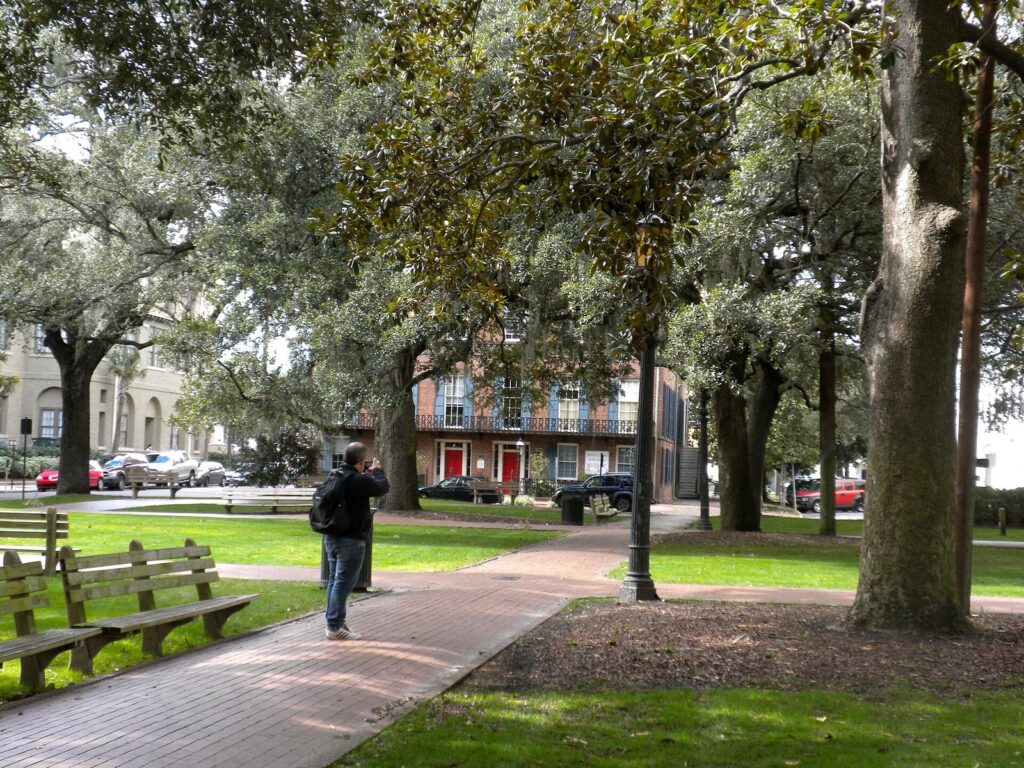
Oglethorpe’s plan built each ward around a square, with lots for churches and public buildings on two sides and houses on the other two. For walkers, that means a shaded rest stop every couple of blocks and streets that line up neatly. For drivers, it means you can’t go straight down Bull Street: cars loop around each square, so a short drive becomes a series of jogs and slow turns. It’s one more reason to walk. Behind the houses run narrow lanes, which are fun to explore but often brick, gravel or broken pavement.
Beyond the Historic District
- The Starland District: the stretch of Bull Street between 37th Street and Victory Drive, south of the Victorian District, known for independent restaurants, bars and galleries. It takes its name from the old Starland Dairy building.
- Midtown and Ardsley Park: early-1900s residential neighborhoods south of Victory Drive, with big oaks and few visitors.
- The Moon River District: the name Visit Savannah gives the waterside communities about 20 minutes south of downtown, including Isle of Hope and Skidaway Island.
- Tybee Island: the beach town, 18 miles east, with its own city government and rules.
A Few Savannah Words to Know
- The squares: the 22 small parks of the Historic District, each named, most with a monument.
- Factors Walk: the iron bridges and lanes along the top of the bluff above River Street, named for the cotton merchants, or factors, who worked there.
- The ramps: the steep cobblestone roads that connect Bay Street to River Street. Wear sensible shoes.
- Lanes: the narrow service streets behind the houses on each block.
- To-go cup: the plastic cup you’re allowed to carry a drink in, within the downtown to-go zone.
- Pluff mud: the soft, pungent marsh mud you’ll smell at low tide and shouldn’t try to walk on.
- Sand gnats: tiny biting insects near the marsh, locally called no-see-ums. Bring repellent.
- Lowcountry: the coastal region of Georgia and South Carolina, and its cooking.
Food and Drink, Briefly
Savannah eats well, and Southern and Lowcountry cooking is the thing to try: fried chicken, shrimp and grits, fresh local seafood and Lowcountry boils. Two institutions belong on a first visit. Mrs. Wilkes’ Dining Room serves family-style lunches on weekdays from 11am to 2pm ($35 for ages 13 and up, cash or check only), and Leopold’s Ice Cream on Broughton Street has been the traditional sweet stop for generations. Weekend dinners at popular places book up, so reserve ahead, and brunch is taken seriously. Our list of the best restaurants in Savannah covers the range.
Three Rules for a First Visit
- Park once and walk. The Historic District is compact, and driving between the squares is slower than walking.
- Walk early and late in warm months. Save the middle of the day for museums, lunch or a break.
- Book the few things that sell out, and leave the rest of the day loose. Savannah rewards wandering.
Where to Stay on a First Visit
For a first visit, stay in or near the Historic District. Being able to walk to dinner, and back to your room for a break on a hot afternoon, makes the whole trip easier. Within that, the choice is about atmosphere:
- River Street and Bay Street: river views and the most evening energy, with noise and cobblestones to match.
- City Market and Ellis Square: central for everything, with plenty of restaurants.
- The squares and Forsyth Park: quieter, leafier and full of historic inns, though many old buildings have stairs and no elevator.
- Hutchinson Island: resort-style, across the river, with the free ferry into town until 10pm.
- Tybee Island: the choice for a beach-first trip, 30 minutes from downtown.
- Near the airport: often cheaper, with free parking, but you’ll drive in and park every day.
Budget for the taxes. Hotel bills add the City of Savannah’s 8% hotel-motel tax, sales tax and Georgia’s flat $5 per-room, per-night state fee, so a quoted nightly rate isn’t the final price. If you’re booking a vacation rental, choose a licensed one: the City requires short-term rentals in the historic districts to hold a City certificate. Our guide on where to stay in Savannah compares the neighborhoods and hotel types.
Getting Around Once You’re Here
Park once, then walk. That’s the whole strategy for downtown Savannah, and a few free services make it easy.
- The DOT Express Shuttle is free and runs two downtown loops with 18 stops about every 10 minutes: weekdays 7am-7pm, weekends 10am-6pm and holidays 10am-6:30pm. It doesn’t run on Thanksgiving, Christmas or New Year’s Day.
- The Savannah Belles Ferry is free and crosses the river daily from 7am to 10pm, about every 20-30 minutes from City Hall.
- City garages are open 24/7 and take cards only.
- A Visitor Day Pass covers on-street meters: $15 for 24 hours or $24 for 48 hours, sold at Mobility & Parking Services in the Bryan Street Garage at 100 E. Bryan St. It doesn’t cover garages.
- Street meters are enforced Monday to Saturday, 8am-8pm, north of Liberty Street, and Monday to Friday, 8am-5pm, south of it.
- Rideshares and taxis fill in at night and for trips outside the center.
You’ll want a car or a ride for Bonaventure Cemetery, Wormsloe, Tybee Island and anything beyond. Our guide to getting around Savannah has garage rates and the shuttle route.
When to Go
The most comfortable times are late March through May and mid-October through November, when highs run from the low 70s to the mid 80s. Spring is the busiest and priciest; fall is nearly as pleasant and often easier to book. Summer is hot and humid, with afternoon thunderstorms and hurricane season from June 1, but it’s beach season on Tybee. Winter is quiet and mild, with January highs averaging 61.4°F. Big events, especially St. Patrick’s Day on March 17, reshape prices, crowds and even opening hours. See our guides to the best time to visit Savannah and to Savannah events and festivals.
What to Book Before You Arrive
Most of Savannah needs no advance planning, but a few things sell out or need a time slot:
- The Davenport House runs timed tours of up to 15 people; book a specific time.
- The Juliette Gordon Low Birthplace recommends buying online in advance; tours sell out in June, July and school holidays.
- The Olde Pink House strongly advises dinner reservations.
- Ghost tours sell out in October; the Sorrel-Weed House’s ghost tour always requires a reservation.
- Savannah Bananas games sell through a lottery the fall before the season.
- Hotels for St. Patrick’s week and festival weekends fill first, so book as soon as your dates are set.
What doesn’t need booking: the squares, Forsyth Park, River Street, the ferry and Bonaventure Cemetery. Mrs. Wilkes’ Dining Room takes no reservations at all; the line starts around 9:30am for an 11am opening.
Closure Days That Catch First-Timers Out
| Day | What’s closed |
|---|---|
| Monday | Telfair Museums (Telfair Academy, Jepson Center, Owens-Thomas House); the Mighty Eighth Air Force Museum |
| Tuesday | Tybee Island Light Station; Tybee Island Marine Science Center; SCAD Museum of Art |
| Sunday | Davenport House; Mrs. Wilkes’ Dining Room (also closed Saturday) |
| Sunday through Wednesday | Pin Point Heritage Museum (open Thursday to Saturday only) |
| Thanksgiving, Christmas, New Year’s Day | The DOT shuttle, the ferry, the visitor centers and many museums |
| St. Patrick’s Day | Many museums, including Telfair’s sites and the American Prohibition Museum |
Local Rules Worth Knowing
- To-go cups: in the downtown to-go zone, from the river south to Jones Street, adults can carry one alcoholic drink each in a cup of 16 ounces or less. No glass, cans or bottles.
- Tybee Island: a separate city with its own rules, including no glass on the beach ($300 fine), no dogs on the beach and paid parking everywhere from 8am to 8pm.
- Cemeteries: the City’s cemeteries are open by day only, and haunted or paranormal tours aren’t allowed in them.
- The squares: they’re public parks surrounded by people’s homes. Keep voices down at night and stay off private steps and gardens.
Staying Safe and Comfortable
The basics cover most of it. In summer, walk early and late, carry water and take the midday heat seriously. Summer storms usually pass within an hour, but lightning is dangerous on the water and at the beach. Hurricane season runs June 1 to November 30; Chatham County’s emergency agency, CEMA, runs alerts that visitors can sign up for. At night, stick to well-lit, busier streets, and use a rideshare for longer trips. In an emergency, call 911.
Where to Get Help and Maps
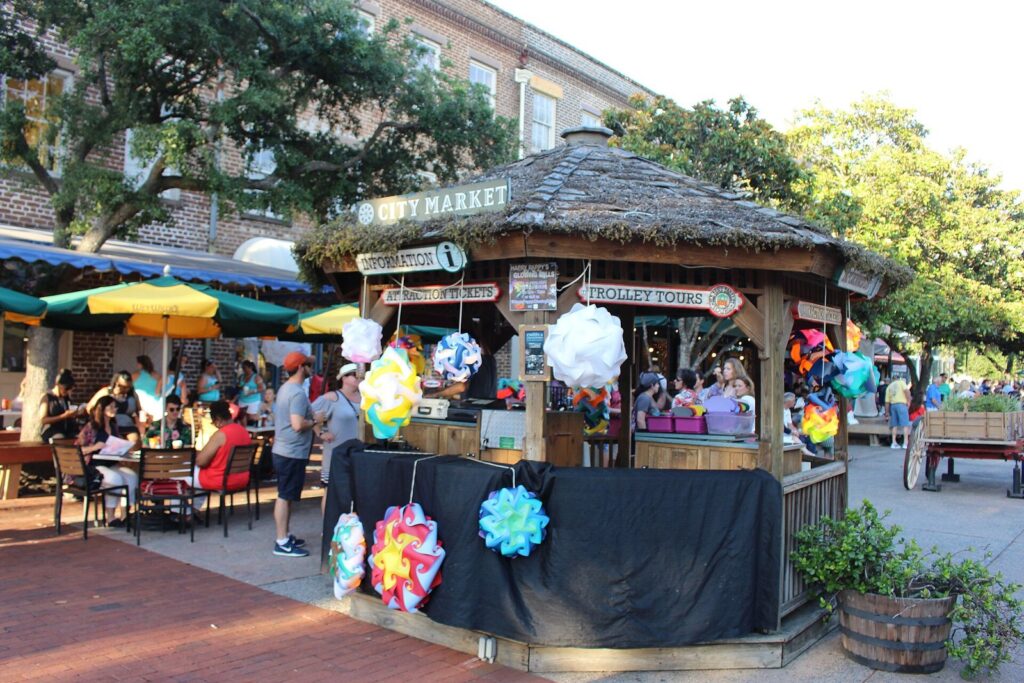
Savannah’s visitor information centers are open 363 days a year, closing only on Thanksgiving, Christmas and New Year’s Day:
- MLK Visitor Information Center, 301 Martin Luther King Jr. Blvd.: daily 9am-4pm (parking passes are no longer sold here).
- City Market Visitor Information Center, 307 W. Julian St.: daily 10am-5pm.
- River Street Visitor Information Center, 1 W. River St.: daily 10am-6pm.
- Airport visitor center, 400 Airways Ave.: daily 8:30am to midnight.
- Tybee Island Visitor Information Center, at Campbell Avenue and US 80: daily 9am-4pm.
They’re the best places to pick up a paper map, ask about the day’s events and check what’s open.
Your First Day: Where to Start
Start with a walk. Head down Bull Street from the river to Forsyth Park, through the squares, and take a narrated tour early on so the history clicks into place. Then pick one historic house to tour, eat a proper Southern lunch and end at River Street for the sunset. Our list of the first-visit essentials covers what to prioritize, and our Savannah attractions guide has prices and hours for everything else.
Traveling With Kids, Seniors or Limited Mobility
Savannah works well for most travelers with a little planning. Families should know that several kid favorites close one or two days a week and that the historic house museums mean a lot of stairs; our guide to Savannah with kids sorts the city by age. Visitors with limited mobility will find the downtown grid flat, the free shuttle, buses and ferry accessible, and two public elevators down to River Street, but many old houses have no elevator; see our accessible Savannah travel guide for what’s step-free.
If You Have an Extra Day
With a third or fourth day, the easiest escapes are Tybee Island, 30 minutes away, and Wormsloe’s oak avenue, 15 to 20 minutes south. Beaufort and Hilton Head, in South Carolina, are about an hour. Charleston, two hours north, is better with a night there. Our guide to the best day trips from Savannah compares drive times, ferries and fees.
First-Time Visitor FAQ
How far is the Savannah airport from downtown?
About 10 miles, or 20 minutes by car, according to the airport. Uber and Lyft pick up at the north entrance of baggage claim, and taxis are metered; at the City’s maximum rates, the ride to the Historic District works out to about $31 before tip. Nine rental-car companies have counters in baggage claim.
Is Savannah a walkable city?
Very. The Historic District is a flat grid with a shaded square every couple of blocks, and most first-visit sights are within walking distance of each other. The free DOT Express Shuttle and Savannah Belles Ferry fill the gaps. Expect uneven brick sidewalks and cobblestones on River Street, and walk early in summer.
Where is the best place to stay in Savannah for first-timers?
In or near the Historic District. River Street and City Market put you in the middle of the action, the squares and Forsyth Park area are quieter, and Hutchinson Island is resort-style with a free ferry into town. Remember that hotel bills add an 8% city tax, sales tax and a $5 nightly state fee.
Do I need a car in Savannah?
Not in the Historic District, where walking, the free shuttle and the ferry cover almost everything. You’ll want a car or rideshare for Bonaventure Cemetery, Wormsloe, Tybee Island and day trips. If you drive in, park in a City garage, which is open 24/7 and takes cards only.
What should first-time visitors know about Savannah?
That it’s hot from June to September, that several museums close on Mondays or Tuesdays, that you can carry a drink in a cup in the downtown to-go zone, that Tybee Island has its own rules, and that the squares are residential. Book timed house tours and popular dinners ahead, and leave time simply to wander.
Is Savannah in Georgia or South Carolina?
Georgia. Savannah sits on the Georgia side of the Savannah River, which forms the state line. South Carolina starts across the river, which is why nearby Hilton Head Island, Bluffton, Beaufort and Charleston are all in South Carolina, while Tybee Island, Wormsloe and the Golden Isles are in Georgia.
Where are the visitor centers in Savannah?
Downtown, at 301 Martin Luther King Jr. Blvd. (daily 9am-4pm), in City Market at 307 W. Julian St. (daily 10am-5pm) and at 1 W. River St. (daily 10am-6pm). There’s also one at the airport and one on Tybee Island. All close on Thanksgiving, Christmas and New Year’s Day.
Related Savannah Guides
- Savannah Travel Guide: the complete overview of planning a Savannah trip.
- Best Things to Do for First-Time Visitors: the essentials to prioritize and what to skip.
- Getting Around Savannah: parking, the free shuttle and ferry, and rideshares.
- Where to Stay in Savannah: neighborhoods and hotel types compared.
- Best Time to Visit Savannah: weather, crowds and prices by month.
Sources and How We Checked
Details were checked September 23, 2026. This guide is compiled from the airport, transit agencies, public authorities and attractions listed below, not from other travel lists, and it doesn’t claim first-hand visits. The taxi fare is our calculation from the City’s published maximum rates.
- Arrival: Savannah/Hilton Head International Airport, surrounding area; airport ground transportation; Amtrak Savannah station
- Visit Savannah: visitor information centers
- City of Savannah: Visitor Day Pass; parking garages; parking meters; short-term vacation rental rules; hotel-motel tax; City Code, to-go cups; cemetery rules
- State of Georgia: State Hotel-Motel Fee
- Chatham Area Transit: DOT Express Shuttle; Savannah Belles Ferry
- History and data: New Georgia Encyclopedia, Savannah; Savannah Area Chamber, 2025 visitor economy; Savannah Historic District marker; Library of Congress, Savannah Victorian Historic District
- Attractions and dining: Davenport House; Juliette Gordon Low Birthplace; Telfair Museums; Mighty Eighth Air Force Museum; Tybee Island Light Station; Tybee Island Marine Science Center; Coastal Heritage Society; The Olde Pink House; Mrs. Wilkes’ Dining Room; Sorrel-Weed House; Savannah Bananas tickets
- Tybee and safety: City of Tybee Island beach rules and parking; Chatham Emergency Management Agency; NOAA climate normals
Savannah Tourism Guide is an independent publication. We are not affiliated with Visit Savannah, the City of Savannah or any attraction listed here, and no one paid to be included.
Photo Credits
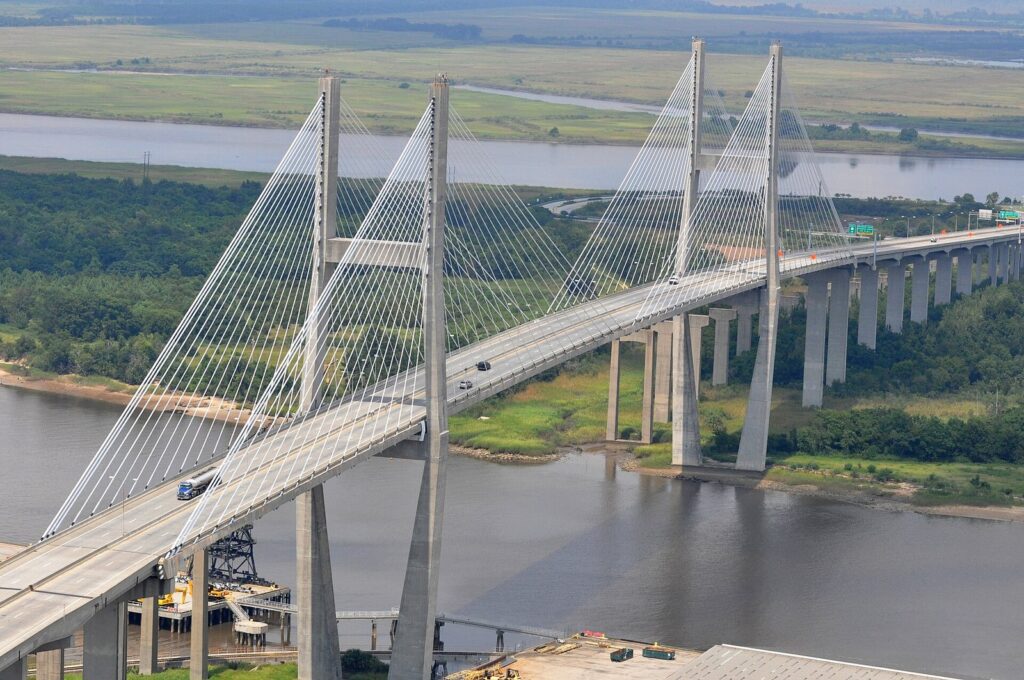
- Talmadge Memorial Bridge: photo by U.S. Army Corps of Engineers Savannah District, Wikimedia Commons (Public domain)
- Savannah riverfront at night: photo by Tim Johnson, Wikimedia Commons (CC BY 2.0)
- Johnson Square: photo by Jennifer Morrow from San Francisco, Wikimedia Commons (CC BY 2.0)
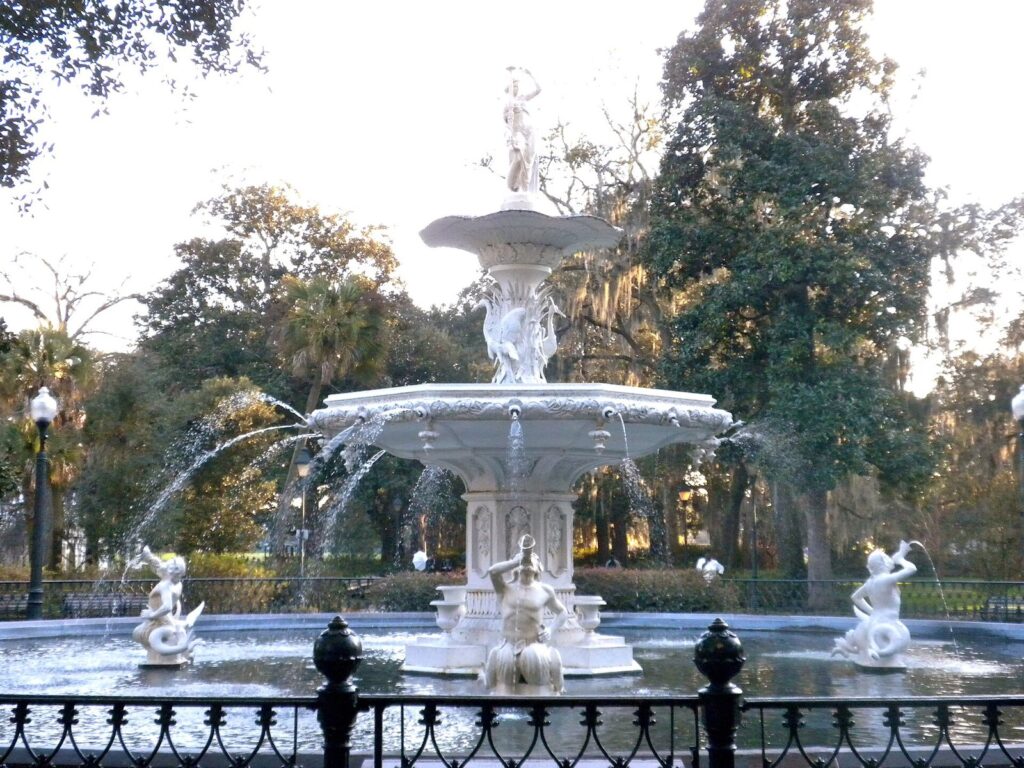
- Forsyth Park fountain: photo by Jennifer Morrow from San Francisco, Wikimedia Commons (CC BY 2.0)
- City Market information booth: photo by Michael Rivera, Wikimedia Commons (CC BY-SA 4.0)